
Wastewater engineering is a vital facet of the civil engineering discipline. Without it, public health would suffer. Wastewater engineering, also referred to as sanitation engineering, is the practice of supplying safe potable water to communities, treating water appropriately according to community needs, and developing wastewater infrastructure to safely remove waste.
What is Wastewater Engineering
Wastewater engineering encompasses the design and execution of the systems that deal with used water. This includes the network of sewer pipes beneath cities, stormwater management systems, water treatment facilities, treatment programs for the water itself, and plant operations.
Wastewater engineering is considered a specialized discipline within environmental and civil engineering. It often requires a deep knowledge of chemistry, biology, physics, mathematics, as well as city planning, mechanical engineering, machinery, and water analysis.
Why is Wastewater Engineering Important?
Without water, civilization as we know it wouldn’t exist. Of course, water is a necessity for daily life. Before the existence of complex and efficient networks to provide clean water, remove used water, and transform dirty water into potable water, life looked a lot different — and lifespans were far shorter.
Wastewater engineering supports public health by providing clean, drinkable water, preventing waterborne disease, and treating water appropriately for the needs of the community.
In addition, it can help conserve resources. By recycling water, especially in places impacted by droughts, wastewater engineering can help address water scarcity. It also supports the growth and development of cities and can help address the environmental impacts, like pollution, that we see in urban rivers.
Lastly, it can protect the environment. Wastewater engineers can play an important role in preserving local ecosystems and natural resources. For example, in Basalt, Colorado, the Basalt Sanitation District discharges its cleaned and treated wastewater into Gold Medal fishing waters. Sitting at a high elevation, there are millions of downstream users who tap into this river. Properly treating this water before discharge has monumental impacts.
By designing the systems to manage and treat water, wastewater engineers play a critical role in protecting public health, enabling sustainable development, and reducing negative effects on the environment. To learn more about a career in this field, check out opportunities at Roaring Fork Engineering.
What Wastewater Engineers Are Responsible for Beyond Design
Most people think of a wastewater engineer as the person who draws the pipes. That’s a fraction of the job.
In practice, wastewater engineers carry responsibility for decisions that affect public health, regulatory standing, and long-term financial stability for the communities they serve. Understanding that scope is important, especially if you’re a municipality, utility district, or public works director evaluating whether and when to engage an engineering firm. Wastewater engineers are often responsible for the following:
Engineer of Record: What It Actually Means
When an engineering firm is named Engineer of Record for a utility or district, they are formally taking on legal and professional accountability for the design and engineering judgment behind a project. That accountability doesn’t disappear after construction. It extends to how the system performs over time, how it holds up against regulatory scrutiny, and whether the design serves operators the way it was intended.
At Roaring Fork Engineering, we serve as Engineer of Record, or on-call district engineer, for seven different entities across Western Colorado. For clients like the Basalt Sanitation District, that relationship has been continuous since 2018. We’re not brought in for a single project and then gone. We’re embedded. We know which manhole floods first in a high-flow event, which piece of equipment has quirks the manual doesn’t mention, and which capital projects need to move to the front of the line. That institutional knowledge is hard to replicate and genuinely valuable when something goes wrong at 10 p.m.
Long-Term Operability, Not Just Buildability
A system that works during construction is the minimum bar. A system that operators can run efficiently, safely, and without constant intervention is the goal. Wastewater engineers who don’t spend time with operators tend to miss this distinction.
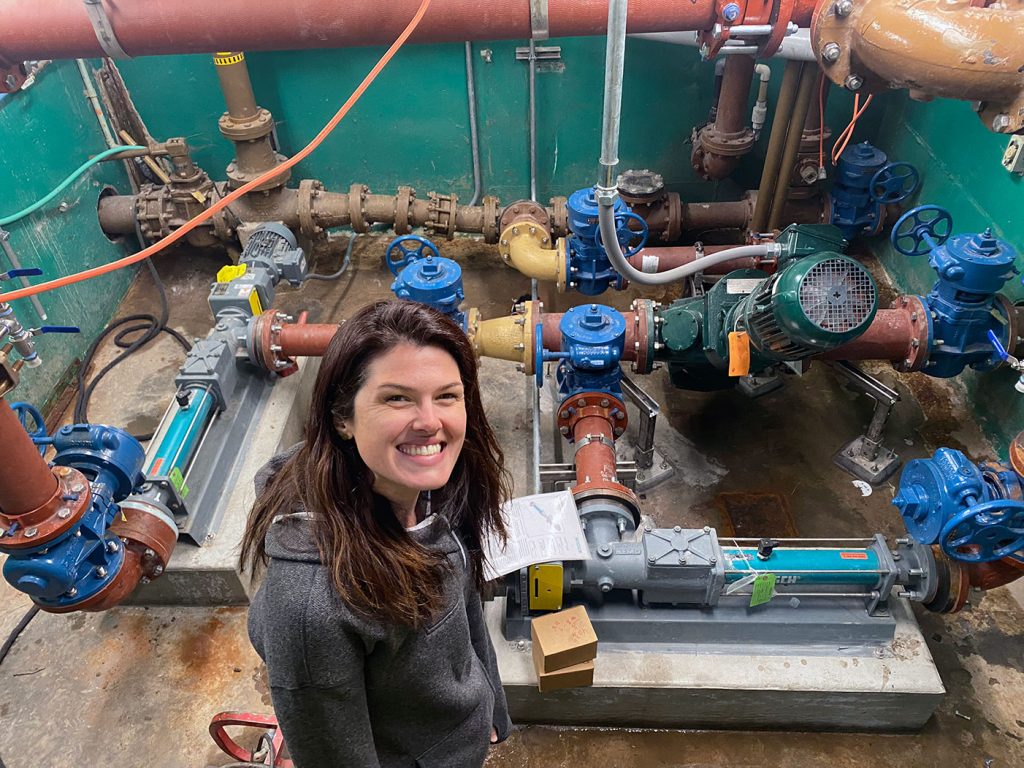
When we upgraded the solids handling systems at the Basalt Sanitation District’s wastewater treatment plant, one of the first things we encountered was a tangle of unlabeled valves, undocumented piping connections, and process controls that no one fully understood. Replacing aging equipment was one objective. But improving operability and giving the plant staff clear, documented control over their most critical processes was the outcome that mattered most. The result was not just more reliable treatment, but operators who could troubleshoot problems independently and maintain effluent quality to the Roaring Fork River.
Regulatory Coordination
Environmental regulations for wastewater are not static. Colorado’s nutrient regulations, the Colorado Department of Public Health & Environment (CDPHE) discharge requirements, and federal programs like the Clean Water Act create a shifting compliance landscape. An engineer of record who is actively tracking regulatory trends helps clients avoid the situation where a capital project they just completed is already insufficient for the requirements coming in five years.
When we conducted a rate study for the Basalt Sanitation District in 2024, we didn’t just look at equipment age. We factored in upcoming nutrient regulations and modeled what compliance would require over the next 20 to 30 years. That analysis shaped the capital improvement plan, which in turn supported the district’s ability to pursue state and federal grant funding.
Protecting Owners from Downstream Liability
Infrastructure failures in wastewater are not just expensive. They can result in regulatory violations, public health emergencies, and legal exposure. A failing sewer crossing that discharges untreated sewage into a waterway triggers immediate regulatory action. A plant that consistently fails to meet its discharge permit creates cumulative compliance risk that can escalate quickly.
Proactive engineering includes identifying failure risks before they materialize, replacing aging infrastructure before it breaks, and designing systems with redundancy. This is the most direct way to protect municipalities from that exposure. For every dollar spent on proactive capital improvement, studies like this one from ASCE consistently show a $3 savings compared to emergency repair, when you account for rush mobilization, expedited materials, emergency permitting, and service disruption.
Anticipating Failures Before They Happen
One of the most valuable things a long-term engineering partner can do is identify what’s about to fail before it fails. That requires knowing the system intimately, understanding which components are original, which ones have been stressed beyond their design parameters, and which ones the operators have been quietly working around for years.
Our infiltration and inflow study for the Basalt Sanitation District identified that a 1972 sewer pipe crossing the Frying Pan River was collecting river water and sending it to the treatment plant, consuming capacity equivalent to 250 single-family homes. The pipe hadn’t failed. But it was going to. By replacing it proactively and encasing the new crossing in concrete for a 100-year service life, we preserved plant capacity, avoided a potential discharge event into a sensitive river, and eliminated a failure that would have been significantly more disruptive and expensive to address after the fact.
Why Early Engineering Involvement Reduces Cost, Risk, and Delays
The most common point at which municipalities and districts engage an engineer is when something is broken or a regulatory deadline is approaching. By that point, the cost of the problem has already grown significantly.
The most successful and most cost-effective public infrastructure projects start with engineering involvement early. Not after a plan has been approved. Not after a scope has been locked. Early. At the point where the fundamental questions about feasibility, system capacity, regulatory exposure, and long-term cost are still being asked.
The Feasibility and Conceptual Stage
For developers, the concept that early engineering saves money is well-established. The same logic applies to municipalities and utility districts, but it’s less consistently practiced.
When the town of Pagosa Springs commissioned a system evaluation of its collection system and lift stations in 2023, the intent was to understand replacement needs and modernize aging infrastructure. What the evaluation uncovered was bigger: the lift stations conveying wastewater to a neighboring district for treatment had failed repeatedly and were fundamentally unreliable. The evaluation revealed that the town needed its own wastewater treatment facility, not just upgraded pipes.
That conclusion would have been far more expensive to reach after committing to a different capital path. Early evaluation redirected the town’s investment toward the right long-term solution, and the new wastewater treatment facility is now in design. It will include water reuse capabilities and a community-integrated design that no one would have reached had the project started with a narrow replacement scope.
How Late-Stage Fixes Escalate Cost
Late-stage engineering changes are expensive for straightforward reasons: by the time a problem is identified during construction, materials have been ordered, contractors are mobilized, and schedules have been set. The cost of fixing a design error or an unforeseen site condition at that point is a multiple of what it would have cost to identify and resolve it during design.
In wastewater specifically, the most common source of late-stage surprises is deferred assessment — systems that haven’t been evaluated in years, where the actual condition of buried infrastructure is unknown. We see this consistently across Western Colorado. When assessments happen early in the project cycle, we can right-size the design, identify scope gaps, and avoid the change orders that tend to accumulate when assumptions replace data.
Entitlement, Permitting, and Regulatory Risk
Wastewater projects often require permits that take longer to secure than project teams expect. Army Corps of Engineers permits for work in or near waterways, CDPHE permits for new or modified discharge, and local approvals for infrastructure in sensitive areas all carry real lead times. Starting that process late, or discovering permit requirements late, can hold up construction for a full season.
Our Frying Pan River Crossing project required Army Corps permitting because the work occurred in a mapped U.S. waterway. We knew this from the earliest stages, designed accordingly, and coordinated with a contractor who had specific river crossing experience. Turbidity control during construction was built into the design. The permit process did not surprise us. It would have, had we not identified the regulatory requirements before design was underway.
Operator Buy-In Early, Not After
Systems designed without operator input get modified after they’re built. Sometimes those modifications are minor. Sometimes they’re significant. In either case, they represent costs that could have been avoided.
Engaging operators early in the design process, which includes understanding their workflows, their maintenance constraints, and the workarounds they’ve built up over the years, produces designs that work in practice, not just on paper. When we design or upgrade wastewater systems, operator input is part of the process, not a post-construction step. The filtration equipment upgrade at Carbondale’s Roaring Fork Water Treatment Plant was specifically chosen to be less maintenance-intensive and easier for operators to run. This was an intentional design choice that came directly from conversations with the people who would be operating it every day.
Common Wastewater Challenges in Mountain and High-Constraint Environments
Wastewater engineering in a mountain town is a different discipline than wastewater engineering on flat terrain near a major city. The physics are different. The regulatory environment is different. The infrastructure history is different. And the consequences of getting it wrong are compounded by remoteness, sensitive ecosystems, and systems that often have no backup.
Firms that design for flat-terrain environments and then apply those approaches to Western Colorado communities tend to underestimate what they’re dealing with.
Steep Terrain and Hydraulic Complexity
Gravity sewer systems depend on a consistent slope to move wastewater without pumping. In mountain terrain, the fact that there’s plenty of slope sounds advantageous. In practice, steep grades introduce their own problems: high-velocity flows that scour pipe materials, air pockets that disrupt flow, and pressure management challenges at the bottom of long descents.
When sewage needs to move uphill or across a valley, ift stations introduce mechanical complexity, electrical dependency, and maintenance requirements. Designing those systems for mountain environments means accounting for power reliability in areas prone to outages, access challenges in winter, and flood risk in valleys where the lowest point is also the most hydraulically logical place for a station.
At the Pagosa Springs First Street Lift Station, the original sewer crossing the San Juan River was hung beneath a bridge. This solution was permissible when it was installed, but would not be approved under current regulations. After the pipe failed, RFE worked with the health department on an emergency permitting process and designed a replacement that raises the pipe above debris flow pathways, converts the gravity crossing to a pressurized force main, and meets modern standards for flood resilience. The solution was more resilient, not merely compliant.
Cold Weather and Freeze-Thaw Cycles
Cold weather creates specific risks for wastewater infrastructure that warmer-climate engineers don’t routinely design around. Pipes that aren’t buried deep enough freeze. Exposed components at lift stations require heat trace and insulation. Treatment processes that depend on biological activity are temperature-sensitive. In a cold snap, a plant can lose treatment efficiency rapidly if it isn’t designed to maintain thermal stability.
Freeze-thaw cycles also stress buried pipes and joints. Ground that expands and contracts seasonally exerts lateral and vertical forces on rigid pipe systems. In steep or unstable terrain, this effect is amplified. At Brush Creek Metro District, which is a community built on a steep hillside, the original pipe system used standard materials suited for stable ground. The subsurface movement of the hillside was shearing pipes apart. When we took on the on-call engineering role for the district, we found them losing 60–70% of their purchased water to leaks. The fix included more than replacement; in addition, we provided material selection: flexible couplings that allow pipe joints to move with the ground rather than resist it. Water loss dropped below 8%.
Aging Infrastructure from the Gold Rush Era
Much of Western Colorado’s infrastructure was installed in the 1960s and 70s — some of it tracing back further to the original mining and agricultural settlements that established these towns. That infrastructure is now approaching or past its design life.
The timing creates a particular challenge: a large volume of components across multiple systems is reaching end-of-life simultaneously. Utilities that deferred replacement work for budget reasons in the 2000s and 2010s are now facing larger capital bills as equipment doesn’t just age but fails. The Basalt Sanitation District’s infrastructure profile is typical of what we see across the region: original equipment from the late 1960s, functioning but increasingly unreliable, and requiring a thoughtful capital replacement sequence that balances urgency with available funding.
Understanding which failures are imminent, which can wait, and which are likely to cascade into larger problems if not addressed is one of the more valuable things a long-term engineering partner provides.
Downstream Environmental Sensitivity
Mountain communities in Colorado discharge treated wastewater into rivers and streams that serve as municipal water supplies, fishing habitat, and recreational resources for large downstream populations. The Roaring Fork River, which receives discharge from the Basalt Sanitation District, is a Gold Medal fishing water. The San Juan River in Pagosa Springs is similarly sensitive.
This environmental context raises the stakes for everything: permit compliance, effluent quality, emergency response, and system redundancy. A discharge event that would be a manageable regulatory issue in a more urban setting can be a significant environmental incident in a mountain river ecosystem. Designing systems that protect receiving waters requires understanding the ecology and hydrology of those systems, not just the regulatory minimums.
Limited Redundancy in Small Systems
Small utilities typically operate without the redundancy that larger systems have. One treatment train. One sewer main serves a significant portion of the collection area. One lift station with no bypass capability. When that single component fails, the impact on service is immediate and often severe.
Engineering for small mountain utilities requires thinking carefully about where redundancy matters most and how to design cost-effectively. The clarifier addition at the Carbondale wastewater plant wasn’t about adding capacity. It was about providing redundancy: the ability to take the existing clarifiers offline for maintenance without interrupting treatment. That operational flexibility, built into a single capital project, eliminated a vulnerability that had constrained the plant’s ability to conduct routine maintenance.
How Wastewater Engineers Coordinate with Operators, Regulators, and Owners
A wastewater project that produces a good design but fails at coordination rarely delivers a good outcome. Designs get built wrong. Permits get delayed. Operators can’t run what was built. Owners face surprises they weren’t prepared for.
Coordination is one of the things that separates competent engineering firms from exceptional ones.
Operator-Informed Design
Plant operators and collection system crews spend more time with wastewater infrastructure than any engineer ever will. They know which valves stick, which pump cycles unexpectedly, and which processes require constant manual intervention because the automation doesn’t work the way it was designed. That knowledge is engineering intelligence. Treating it as such produces better designs.
Our practice is to engage operators early and keep them engaged through design and construction. When we undertook the solids handling upgrade at Basalt Sanitation, the operators’ familiarity with the existing system and all of its undocumented quirks shaped what we replaced, what we retained, and how we configured the new controls. The goal was a system they could operate confidently, not one that looked elegant on a drawing but required an engineer on-site to troubleshoot.
This approach also reduces post-construction friction. Operators who understand why a system was designed a specific way are more likely to operate it correctly and flag issues early, before they become significant problems.
Navigating Agency Expectations
Wastewater projects typically involve multiple regulatory agencies with different processes, timelines, and expectations. Navigating that landscape efficiently requires familiarity with the agencies themselves, not just the regulations they administer.
Firms that work in a region consistently develop that familiarity. We know which CDPHE reviewers have jurisdiction over specific project types, what level of documentation they expect, and how to structure submittals to minimize back-and-forth. We know when Army Corps permit timelines will drive a project schedule and how to plan around them. That institutional knowledge doesn’t appear on a scope-of-work document, but it shows up consistently in project outcomes.
Clear Accountability for Owners
Municipal and district clients are accountable to ratepayers, council members, and boards who need to understand what is being spent and why. Wastewater engineers who work effectively with public clients communicate clearly about tradeoffs, provide defensible documentation for major decisions, and don’t obscure risk behind technical language.
When we conducted rate studies for our municipal clients, the deliverable wasn’t just a spreadsheet. It was a documented analysis that a district board could present to ratepayers: here is what our aging infrastructure requires, here is what compliance with upcoming regulations will cost, and here is what rates need to be to fund those needs over the next generation. That kind of clear, owner-facing communication is part of what we’re hired to provide.
For clients who are pursuing grants and loans, clear documentation has direct financial value. Funding agencies consistently ask whether a rate study and capital improvement plan are in place before approving applications. Clients who have that documentation are better positioned to compete for limited funds.
Avoiding Surprises During Review and Construction
The most disruptive surprises in a wastewater project are the ones that emerge during regulatory review or after construction begins. A permit condition that requires a design change. An unforeseen site condition that requires additional work. A construction sequence conflict that stops a contractor mid-project.
Preventing these surprises is partly about thoroughness and partly about communication. Thorough pre-design investigation, like site assessments, existing condition surveys, and subsurface data collection reduces the probability of encountering surprises during construction. Clear, early communication with regulators reduces the probability of permit conditions that weren’t anticipated.
Learn More About Wastewater Engineering with RFE
Roaring Fork Engineering is Colorado’s premier water resources management firm. Our work spans sustainable water infrastructure, to local water treatment plants, to safeguarding your property or construction site from stormwater runoff.
Our comprehensive services in civil and environmental engineering provide a broad and diverse perspective on strategy and design. For example, see how we provided key insights for the design of the Carbondale Wastewater Treatment Facility.
If you have a wastewater or water resource engineering project in mind, get in touch.
Frequently Asked Questions About Wastewater Engineering
When should a municipality bring in a wastewater engineer?
Earlier than most do. The most effective and cost-efficient point to engage a wastewater engineer is during the planning or feasibility stage, before a project scope is set. Early engagement allows the engineer to identify what the project actually requires, flag regulatory issues that will affect schedule and cost, and help the municipality understand the full scope of what they’re dealing with. The typical trigger for engagement is infrastructure failure or an approaching regulatory deadline. Both are manageable starting points, but both carry costs that could have been reduced with earlier involvement.
What happens if wastewater systems aren’t upgraded in time?
The consequences accumulate. Aging infrastructure has the potential to fail at any point, but especially under peak conditions, in cold weather, or during high-flow events. When it does, the cost of emergency response is significantly higher than planned replacement: rush mobilization, expedited materials procurement, emergency permitting, and service disruption all compound the bill. Beyond cost, a wastewater failure can trigger regulatory violations, environmental impacts, and public health emergencies. In Colorado, discharging untreated or undertreated wastewater into a river carries serious regulatory consequences, particularly in the sensitive mountain watersheds where most Western Colorado utilities operate.
How do wastewater engineers work with operators and maintenance teams?
Effectively and continuously, if the relationship is working as it should. Plant operators and collection system crews have ground-level knowledge about how infrastructure actually performs that no engineer can develop from drawings alone. Good engineering firms treat operators as collaborators by engaging them during design to understand operational constraints, incorporating their input into equipment selection and process design, and training them on new systems after construction. The result is designs that are operable in practice, not just on paper, and operators who can troubleshoot problems without waiting for an engineer to arrive on-site.
Is wastewater engineering required for grants or regulatory approvals?
Yes, in most cases. State and federal funding programs, including Colorado’s DOLA and CWCB infrastructure programs, require engineering documentation as part of grant and loan applications. Reviewers typically look for a current rate study, a capital improvement plan, and evidence that proposed projects have been evaluated by a licensed engineer. Regulatory permits for new or modified wastewater facilities, sewer line work in sensitive waterways, and discharge permit modifications all require engineering submittals prepared and signed by a licensed Professional Engineer. Having an ongoing engineering partner who has already developed that documentation shortens the path to both funding and approval.
How do terrain and climate affect wastewater system design in Colorado?
Significantly. Steep terrain changes hydraulics, increases maintenance complexity, and exposes infrastructure to freeze-thaw stresses and ground movement that flat-terrain designs don’t account for. Cold weather affects treatment performance, creates freeze risk for exposed components, and complicates winter construction access. The mountain rivers that receive treated discharge in Western Colorado are highly sensitive ecologically, which raises the stakes for permit compliance and system reliability. And many of these communities are served by small utilities with limited redundancy, which means a single-point failure can affect service immediately. Designing for these conditions requires familiarity with the region, not just with wastewater engineering principles in the abstract.
What’s the difference between a design-only engineer and an Engineer of Record?
A design-only engagement produces deliverables: drawings, specifications, and calculations. The engineer’s responsibility is largely limited to the accuracy of those documents. An Engineer of Record relationship is broader and ongoing. The engineer of record carries professional accountability for engineering judgment across the life of the project and often across multiple projects over many years. They’re available for construction oversight, regulatory coordination, operator support, and emergency response. They know the system. When something goes wrong, they’re the first call. Municipalities and utility districts that treat engineering as a series of one-off design contracts often find themselves without a partner who has the institutional knowledge to respond effectively when that knowledge matters most.